
QriTical is a site where interdisciplinary collaborations flourish at Mount Royal University. By bringing together researchers from diverse disciplines, our centre has facilitated intellectual connections among two cohorts of affiliated faculty. Our faculty have created exciting undergraduate research opportunities and produced research outcomes with tangible social and academic impact.
Read about some of our QriTical collaborations here:
“‘The Bill Chill’: Teaching and Learning about Gender and Sexual Diversity in Contemporary Alberta
Corinne L. Mason, Jill Thompson, Lisa Gasson-Gardner, and Victoria Bucholtz
Scholarship of Teaching and Learning Collaborative Grant, $6763.00
Four faculty researchers affiliated with the QriTical: queer + trans research hub will investigate the existence of a “chilly climate” at MRU. A “chilly climate” can be defined as campus conditions in which marginalized students and faculty experience exclusion and/or devaluation in teaching and learning. In the context of growing anti-2SLGBTQIA+ sentiments and the politicization of higher education’s commitments to equity, diversity and inclusion, this project will explore how 2SLGBTQIA+ faculty and students are navigating identity disclosure and how they share knowledge about gender and sexual diversity in classrooms.
Exploring Gender Euphoria through Arts-Based Action Research with Youth
Celeste Pang, Leah Hamilton, Corinne L. Mason, Gio Dolcecore (2023-26), Jill Thompson
SSHRC Explore (Internal Research Grant), $7000
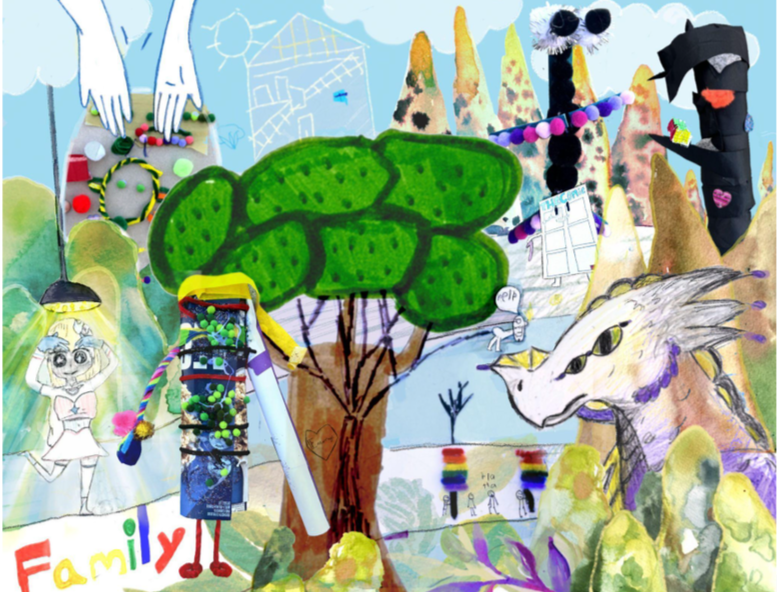
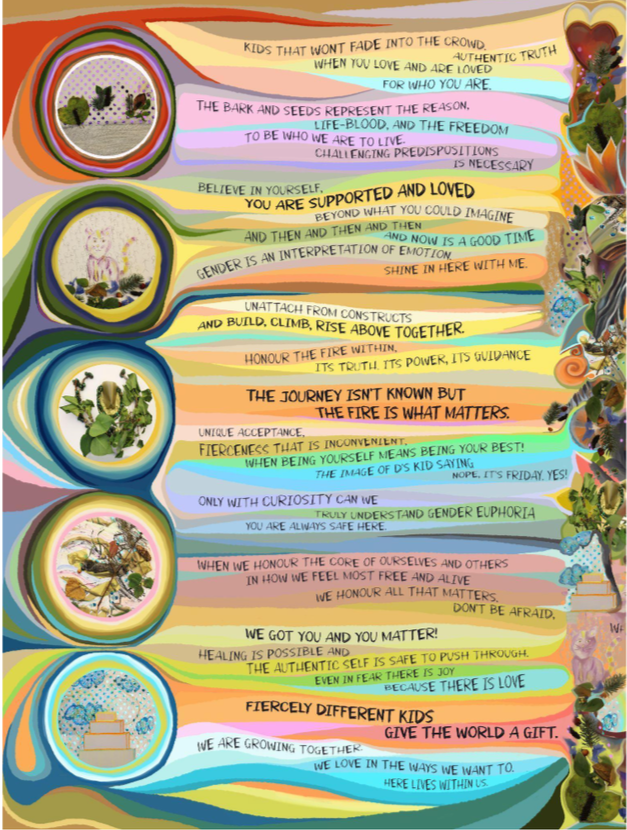
This participatory arts-based action research project investigated how Calgary-based trans and gender diverse youth and their caregivers define and experience “gender euphoria.” It was motivated by parents and caregivers of trans and gender diverse youth in the community who approached QriTical with a desire inform institutions (like healthcare settings) how best to support youth in the context of rising anti-trans sentiments in the province. The researchers partnered with social artists, Katie Green and Melanie Schambach, to co-create two murals that have been gifted to Skipping Stone, Metta Clinic, and MRU Childcare Centre. For this project, researchers hired two research assistants for data collection and Avery Follett (Faculty of Arts) presented their work on this project during the Get QriTical! Student Colloquium in 2025 (MRU Research and Scholarship Days) and is a co-author of an academic article in-progress (as of April 2026).
AI, False Responders, and Lessons from 2SLGBTQIA+ Research
QriTical Hub and Egale Canada
Report (in progress)
In Fall 2025, QriTical convened an online panel focused on how AI has impacted online data collection for 2SLGBTQIA+ focused projects and strategies that university and community-based researchers have used to mitigate these impacts. The panel brought together experts from the Community-Based Research Centre, the Open Literacy and Access Network, and Concordia University, and was attended by more than 80 people including MRU staff, academics, and community-based researchers. The recording is available online for ongoing teaching and learning. In addition, the conversations sparked among panelists and audience members has resulted in the collaborative authorship of a public-facing report “Bots, AI, and False Responders as Roadblocks in Online Research with 2SLGBTQIA+ Communities”, with the above-named organizations, Egale Canada, and QriTical as partners. This report is soon to be made available in English and French.
Queering Home: Using Photovoice to Explore 2SLGBTQ+ Adults' Shared Housing Models and Practices
Celeste Pang, Victor Perez-Amado (Toronto Metropolitan University), Gloria Pérez-Rivera (2023-25), Brittany Jakubiec (Egale Canada)
SSHRC Insight Development Grant, $68,764
Queering Home builds on multi-year collaborations among the investigators and their students. This study examines shared housing models and practices among 2SLGBTQ+ adults in Ontario and Alberta who have chosen intentional and long-term cohabitation with others with whom they are not legally related or romantically involved (e.g., friends). It uses photovoice methods, a participatory action research method that combines photography and group discussion. The study asks: (1) Why do 2SLGBTQ+ adults enter into long-term shared housing arrangements with others to whom they are not legally related or romantically involved, and what meaning do they make from their cohabitation situations and practices?; and (2) How do intersections of age, ability, race, migration experience, socio-economic status, and housing policy context shape the formation and practices of such households? Through this study, the researchers aim to learn more about the social and economic drivers and impacts of shared housing, and build critical knowledge relating to the intersection of housing and 2SLGBTQ+ identities and social relations. This study is ongoing; researchers have hired one MRU research assistant, Mira Cappello (Faculty of Arts) and one research consultant, Julia Menezes, a TMU graduate who was recently accepted into a PhD program at the University of Toronto. Both are assisting with data collection and will be part of future co-authored presentations/publications
Parental Rights in ‘God’s Dominion:’ A Case Study of Canadian Christian Nationalism in Alberta.
Lisa Gasson-Gardner and Corinne L. Mason
Article, Studies in Religion (Accepted)
This article is a collaboration that relies on Gasson-Gardner’s expertise in Christian Nationalism and Mason’s research on the impact of anti-2SLGBTQIA+ legislation and regulations in Alberta, including the K-12 ‘book ban.’ In this article, researchers draw on history, reporting, and online sources to present an analysis of the parental rights movement to propose a framework for the study of Canadian Christian Nationalism. Using the case of the K-12 ‘book ban’, researchers map how the Alberta parental rights movement mobilizes two key mechanisms of identification with Christian Nationalism: the “power devaluation crisis,” which raises alarm about historically empowered groups losing power, and the “declensionist narrative,” which claims society is in decline. This article demonstrates how Canadian Christian Nationalism is emerging through a common-sense politics mobilized by appeals to Canada’s past as “God’s Dominion” and strong feelings about parental authority. Both Gasson-Gardner and Mason have given multiple media interviews on the topic, Gasson-Gardner will be presenting this paper at the Canadian Society for the Study of Religion.
TransAthletics: Examining Community and Institutional Impacts of Anti-Transgender Ideologies on Sport in Alberta
Gio Dolcecore (2023-25), Celeste Pang, Evan Bosnjak (Independent Researcher)
SSHRC Explore (Internal Research Grant), $7000
TransAthletics is a qualitative interview-based study focused on the impacts of anti-transgender ideologies and Alberta’s Fairness and Safety in Sport Act. We ask (a) How are anti-transgender ideologies and policies impacting the ability of trans, nonbinary, and gender-diverse people to participate in sport in Alberta?, and (b) How are those working in impacted institutions and athletic organizations from a trans-inclusive allied position negotiating the current anti-trans climate, including making sense of Bill 29 and acting to implement it in policy? This study builds on an ongoing collaboration among the researchers that included a pilot study and organization of multiple initiatives focused on educating the public about trans inclusion in sport. To date, we have co-authored two articles for The Conversation, given six presentations, including internally at MRU, at the Moving Trans History Forward Conference, and at the Calgary Public Library, and multiple news interviews including to CBC News. For the current study, we hired research assistant Kayde dePestel (Faculty of Arts) who gave one presentation on his course-based research at the Get QriTical! Student Colloquium in 2026 (MRU Research and Scholarship Days) and will be involved in data analysis and future co-authored presentations and publications.